Showing posts with label disaster reduction agency. Show all posts

Wednesday, April 18, 2012

Proven approaches for empowering women smallholders and achieving food security


What Works for Women: Proven approaches for empowering women smallholders and achieving food security
28 pages

The question of 'what changes do we need to empower women smallholders and achieve food security?' has been asked repeatedly. But transformational changes in both public policy and practice have been few and far between, although increasing access to resources and opportunities for women farmers could substantially reduce the number of hungry people in the world. In this context, nine international development agencies (ActionAid, Care, Christian Aid, Concern Worldwide, Find Your Feet, Oxfam, Practical Action, Save the Children, and Self Help Africa) have produced a briefing to share the lessons learned based on their experience of promoting gender equality and working with women smallholders and rural women over many decades. The paper concludes with a number of recommendations for policy makers on measures to help close the gender gap in agriculture.


Read in detail about the document at :- http://www.cdrn.org.in/show.detail.asp?id=23598

Wednesday, December 7, 2011

Climate change will hit Indian cereals, benefit legumes

Climate change will hit Indian cereals, benefit legumes

Athar Parvaiz Bhat

28 November 2011 | EN

India could produce fewer cereals but more legumes due to climate change.

David Dickson

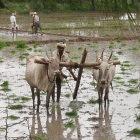
[NEW DELHI] Indian farmers could be producing less rice and wheat and more legumes as a result of global warming, a senior crop scientist has said.

Climate change would have a negative impact on cereal crops such as wheat and rice, Bandi Venkateswarulu, director of Central Research Institute for Dryland Agriculture, Hyderabad, told a South Asia media workshop on climate change in Delhi this month (17 November).

On the other hand, Venkateswarulu told the workshop organised by the Delhi-based non-government organisation, Centre for Science and Environment, legumes such as soybean and groundnut will benefit from the change in temperature.

The productivity of most cereals in India would decrease due to rise in temperature and decline in water availability. "A projected loss of 10–40 per cent will occur in crop production by 2100," he said.

A rise of one degree Celsius could reduce yields of major food crops by three to seven per cent in India, with higher losses during the winter (rabi) crop season, he added.

The growing period for crops in rain-fed areas, which account for two-thirds of India's cropland, could reduce.

Rainfall variations would impact summer (kharif) crops; while changes in minimum temperatures would influence the winter crops. Both temperature and rainfall changes would affect rice production in the Indo-Gangetic plain.

Wheat production in irrigated lands is projected to decline by six per cent by 2030. “The higher temperature will also make the wheat crop susceptible to wheat rust because wheat is found to be more susceptible to rusts at higher temperatures,” he observed.

Soyabean yields are projected to rise by 8–13 per cent and groundnut by up to seven per cent by 2030, he said.

"Apart from this, it has been found that there has been a shift of the apple belt to higher elevations in Himachal Pradesh state because of inadequate chilling in the plains — crucial for good apple yields," Venkateswarulu said. ]


Read the detailed article at :- http://www.cdrn.org.in/show.detail.asp?id=22926

Friday, March 11, 2011

To build the resilience of nations and communities to disasters, we need equal and active participation of men and women in disaster risk reduction.

To build the resilience of nations and communities to disasters, we need equal and active participation of men and women in disaster risk reduction.


Type:News briefs
Date:8 Mar 2011
Source:United Nations International Strategy for Disaster Reduction Secretariat (UNISDR)
Language:English


Disasters affect men and women differently, and so we will continue to lobby for gender-sensitive vulnerability, risk and capacity assessments. Studies show that women’s vulnerabilities during and after disasters is linked to their role and status in society, making women and children 14 times more likely to die than men during a disaster.

At the same time, we will work towards increasing women’s understanding, knowledge and capacity on disaster risk reduction, and of its links with other development sectors. We will continue to encourage governments to invest in discovering women’s needs, so that women are better able to prepare for, and respond to, disasters.

However, advancing gender perspectives and women’s rights is not just a job for women – more men must advocate at a high level for the empowerment of women, and for the incorporation of gender budgeting into national and local development plans.

The United Nations has increased its leadership in gender issues and UN Women has been created for concerted action in promoting gender equality in and outside the United Nations system. For its part, the UNISDR secretariat has the mandate and responsibility for gender mainstreaming in disaster risk reduction, in line with the Hyogo Framework for Action adopted by 168 countries at the World Conference on Disaster Reduction in 2005.

Making disaster risk reduction gender sensitive will secure the equal participation of men and women in policy making and policy implementation in disaster risk reduction, making it possible to achieve disaster-resilient nations and communities. And, as the frequency and impact of climate-related disasters increases, UNISDR is committed to building a culture of prevention that is founded on the specific needs, voices, roles, and potential of women, men, boys, and girls.


***********
Margareta Wahlström
Special Representative of the Secretary-General on Disaster Risk Reduction
March 2011


Related Links
UNISDR Publications: Gender and Disaster Risk Reduction

Contact Information
Other Details

UNISDR
9-11 Rue de Varemb
1202 Geneva, Switzerland
Tel: +41 22 917 8908/8907
Fax: +41 22 917 8964